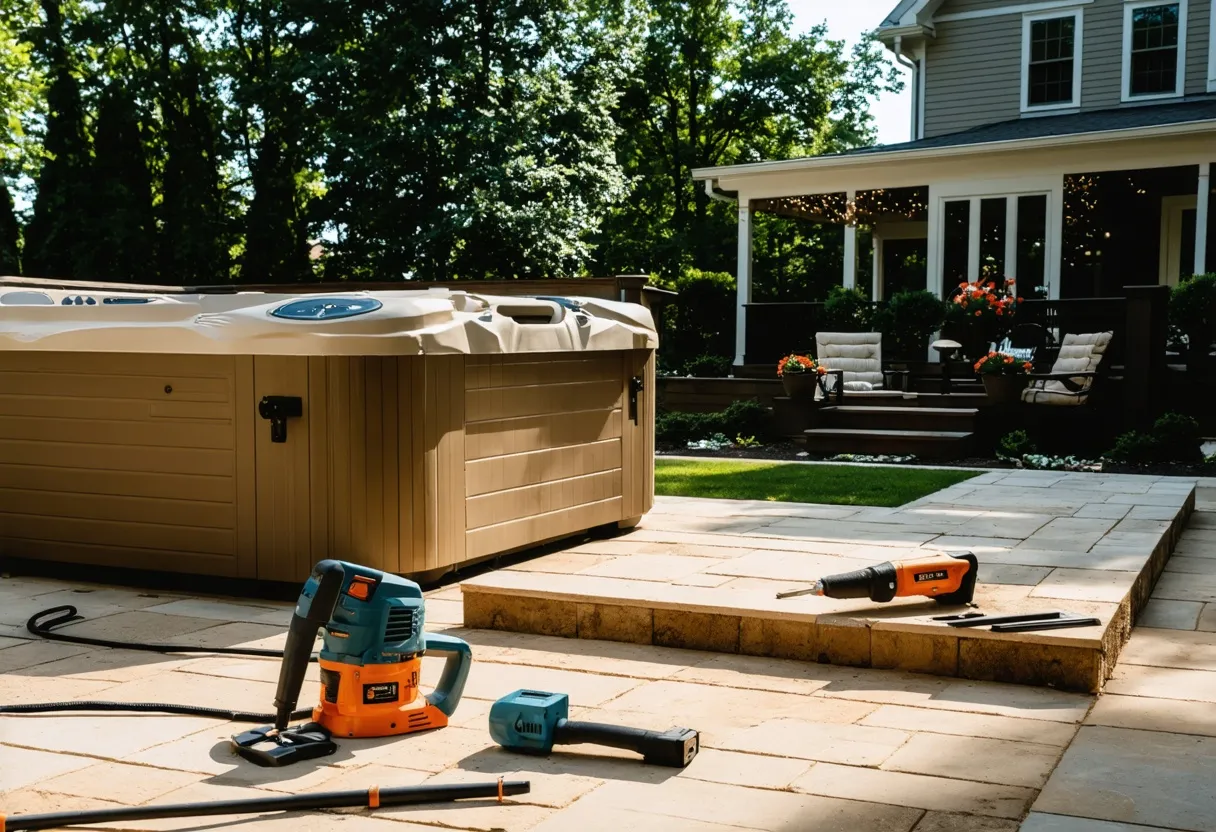
If you've been searching for custom spa and hot tub installation in Greenville, SC, you've probably noticed the same problem we hear about constantly: national hot tub retailers can drop a portable spa on a slab in a weekend, but they can't tie that spa into a new gunite pool, build it into a raised stone wall with a spillway, or navigate the soil and permitting realities that come with building in the Piedmont. That's a different trade entirely. We specialize in custom-built, plumbed-in spas and hot tubs — standalone inground spas, raised spillover spas, and full pool and spa combo builds — engineered specifically for Greenville-area lots, clay soil, and the dual-jurisdiction permitting that trips up out-of-town contractors.
This page walks through everything that goes into a custom spa or hot tub project here: the construction types available, what actually drives the price up or down, how our permitting and grading process works on Upstate SC lots, financing options, equipment packages, and the maintenance side most homeowners don't think about until year two. If you're comparing quotes or just trying to understand what you're buying, read through — this is the same information we walk clients through at the kitchen table before a shovel ever hits the ground.
01What "Custom Spa and Hot Tub Installation" Actually Means
There's a real difference between buying a portable hot tub and building a custom spa. A portable unit ships from a factory, gets craned or rolled onto a pad, and plugs into a dedicated circuit. A custom-built spa is constructed on-site out of gunite, vinyl, or fiberglass, plumbed with its own dedicated circulation and heating system, and tied structurally and visually into your yard — whether that's a standalone in-ground spa with a stone veneer, a raised spa that spills into an adjoining pool, or a fully integrated pool and spa combo poured as one continuous structure.
Custom installation covers:
- Site evaluation, soil testing, and grading design specific to your lot
- Structural design (gunite shell, vinyl liner wall/floor package, or fiberglass shell placement)
- Plumbing and hydraulic design — separate spa circulation loop, jets, and a dedicated or shared heater
- Electrical coordination for pumps, heaters, blowers, and automation
- Decking, coping, and hardscape that ties the spa into the surrounding patio
- Sanitization system selection (saltwater chlorination, UV, ozone, or traditional chlorine feed)
- Automation integration so the spa can be controlled independently from the pool
- Permitting through the correct city or county building department, plus HOA coordination where applicable
In other words, it's a small, high-intensity construction project — not an appliance delivery. That's why pricing, timeline, and process look completely different from a big-box hot tub purchase, and why the contractor's licensing and construction experience matter more here than almost anywhere else in a backyard project.
02Pool Types and How Spas Pair With Each
The right spa build depends heavily on which pool structure (if any) it's paired with. We build and integrate spas with all three major pool types used in the Greenville market:
Gunite (Shotcrete) Pools and Spas
Gunite is poured/sprayed concrete reinforced with steel rebar, finished with plaster, pebble, or quartz aggregate. It's the only material that allows a truly custom spa shape — spillways, raised walls, tanning ledges, and irregular geometry are all straightforward with gunite because the shell is formed and sprayed to your exact design. Most of the inground spa and pool and spa combo work we do in Greenville is gunite, specifically because it's the only method that lets us match a spa's shape and elevation to a sloped Upstate lot instead of forcing the lot to match a pre-made shell.
Vinyl Liner Pools
Vinyl liner construction uses a wall panel system (usually polymer or steel) set on a compacted or sand base, with a custom-cut liner. It's the most budget-friendly pool structure, and it can support an attached spa, but the spa itself is typically framed and built with a separate structural approach since liner material isn't suited to complex jet plumbing or raised walls. Vinyl works well for homeowners prioritizing lower upfront cost with a simpler attached spa or a standalone gunite spa next to a vinyl pool.
Fiberglass Pools and Spas
Fiberglass shells are manufactured off-site and set into an excavated hole in one piece, which means installation is fast — often days rather than weeks for the shell itself. Some fiberglass manufacturers offer matched fiberglass spa shells designed to sit adjacent to or attached to their pool shells. The tradeoff is customization: you're choosing from a manufacturer's shape catalog rather than designing a one-off spa. Fiberglass makes sense for homeowners who want a faster install timeline and are comfortable with a standard spa shape and size.
We'll walk you through the tradeoffs for your specific lot, because on many Greenville properties, the terrain itself narrows the decision before budget even enters the conversation — more on that below.
03Piedmont Terrain and Soil: Why It Changes Your Spa Design
This is the part most out-of-town or big-box installers skip past, and it's the part that causes the most expensive change orders after a project has already started. Upstate South Carolina sits in the Piedmont region, and the soil and terrain here behave very differently from the sandy coastal soils most national spa and pool marketing is written for.
Two conditions show up repeatedly on Greenville-area lots:
- Red clay with variable moisture retention — clay expands when wet and contracts when dry, which means a spa or pool shell set on unstabilized clay can shift over seasons if the base isn't properly compacted and engineered. This is especially critical for raised spa walls, which carry more lateral load than a flat pool floor.
- Rock and saprolite close to the surface — much of the Piedmont sits on partially weathered granite (saprolite) that can transition to hard rock at shallow depth. A site that looks like straightforward dirt can hit rock two or three feet down, which affects excavation method, timeline, and cost.
Before we quote a custom spa or pool and spa combo, we run a site evaluation that looks at drainage patterns, existing grade, slope toward or away from the house, and probe the soil to get a sense of what the excavation crew will actually hit. On sloped lots — which describes a large share of the properties we work on around Greenville — a raised or vanishing-edge spa design can sometimes turn a grading problem into a design feature, using the natural slope to create the spillway effect instead of fighting it with imported fill.
This matters just as much for drainage after construction. Clay doesn't perc well, so spa and pool decking needs proper slope and, in many cases, a dedicated drain line tied into the yard's stormwater path — not just graded to "run off somewhere." Skipping this step is one of the most common reasons homeowners call us for repair work on a pool or spa another company installed.
04Permitting: Why Greenville Is a Dual-Jurisdiction Market
One detail that surprises a lot of homeowners: whether your spa or pool falls under City of Greenville permitting or Greenville County permitting depends entirely on which side of the municipal line your property sits on — and the requirements, inspection sequencing, and setback rules aren't identical between the two. If your property is inside city limits, you're working with the city's building and zoning department; if you're in unincorporated Greenville County (which covers a large share of the surrounding area), you're working with the county's permitting office and its own inspection schedule.
A custom spa or pool and spa combo typically requires:
- A building permit for the structure itself (pool/spa shell, decking, and any retaining walls)
- An electrical permit for pump, heater, blower, and automation circuits
- A barrier/fencing permit or code compliance review, since both the city and county enforce pool barrier requirements
- Setback verification from property lines, septic fields (common on larger lots outside the city), and easements
- HOA design review, where applicable — many newer Greenville-area subdivisions have their own approval process layered on top of the municipal permit
We handle the permit applications and inspection scheduling as part of the build so you're not the one shuttling paperwork between departments. Because we build across both jurisdictions regularly — including projects outside the city in Simpsonville and Taylors — we know which inspector is asking about which detail before it becomes a delay.
05Pricing and Cost Breakdown
Custom spa and hot tub pricing in the Greenville market varies more than almost any other part of a pool project, because so much depends on structure type, jet count, plumbing complexity, and whether the spa is standalone or combined with a pool. Rather than quote a single number, here's how the tiers generally break down:
- Standalone vinyl-adjacent or smaller gunite spa (freestanding, basic jet package): the entry tier — a compact in-ground spa with standard circulation, a handful of jets, and simple coping. Best for homeowners who want a true built-in spa without a full pool build.
- Mid-tier gunite spa with spillway into an existing or new pool: adds the raised wall structure, spillway weir, additional jet zones, and a matched finish to the adjoining pool's plaster or aggregate.
- Full pool and spa combo, custom shape: the pool and spa are engineered and poured together, sharing (or separately zoning) equipment, with coordinated decking, water features, and finish. This is the most common request we get from homeowners planning a complete backyard rebuild rather than an add-on.
- Premium/fully custom builds: multiple spillways, raised sun shelves, integrated fire features, high-end automation, and premium decking materials (travertine, stamped and stained concrete with custom patterns, natural stone).
What actually moves a quote up or down within those tiers:
- Excavation difficulty — rock encountered during digging (common in parts of the Piedmont) adds equipment and labor cost that a flat sandy-soil quote wouldn't include
- Jet count and hydrotherapy features — each additional jet zone means more plumbing runs and a larger or second pump
- Shared vs. dedicated heating — a spa that needs to reach a higher temperature than the pool independently, on its own schedule, typically needs its own heater
- Decking material — stamped concrete, pavers, and natural stone all carry different material and labor costs, and slope correction on graded lots adds base preparation
- Automation level — app-based control, that lets you fire up the spa from your phone before you get home, costs more than a basic timer-and-switch setup
- Sanitization system — saltwater chlorination systems cost more upfront than manual chlorine feed but reduce ongoing chemical handling
For a detailed, line-item look at how these cost drivers stack up and what current material pricing looks like, our pool cost and financing breakdown for Greenville homeowners goes deeper into real project ranges than we can cover in a single section here.
06Financing a Custom Spa or Pool and Spa Combo
Most homeowners financing a custom spa or combo project aren't paying cash outright, and there are meaningfully different paths depending on your situation:
- Home equity line of credit (HELOC) — often the lowest interest rate option if you have equity built up, since it's secured by the home
- Pool-specific installment loans — offered through several lenders that specialize in pool and outdoor living financing, usually with fixed monthly payments and terms from 5–20 years
- Cash-out refinance — makes sense in some rate environments, less so in others; worth running the math against a HELOC before committing
- Contractor-facilitated financing — many builders (including us) work with third-party lenders who specialize in pool/spa projects and can pre-qualify you during the design phase, before final pricing is locked
The right choice depends on your equity position, credit profile, and how the monthly payment fits your budget relative to the project tier you're considering. We walk every client through financing options as part of the initial consultation, and our financing comparison guide breaks down typical rates, terms, and qualification factors in more detail if you want to run numbers before your first meeting.
07Design and Customization
Design is where a custom spa earns the word "custom." Beyond shape and size, the decisions that shape the finished product include:
- Spa placement relative to the pool — attached with a spillway weir, elevated on a raised wall, or freestanding at a distance with its own decking
- Interior finish — plaster, pebble aggregate, or tile, matched or intentionally contrasted with the pool finish
- Jet layout — hydrotherapy jets positioned for seated use, with zones you can control independently (lower back, calves, full-body)
- Water feature integration — spillways, bubblers, or deck jets that connect visually and audibly to the pool
- Lighting — LED color-changing lights synced with the pool's lighting or set independently
- Shape and scale — a spa sized for two people looks and functions very differently from one built for six, and that difference shows up directly in seating ledge width and jet count
Because gunite construction is formed on-site, we can adjust the design to match an irregular lot line, an existing patio, or a specific view line toward the backyard's best feature — something a pre-fabricated fiberglass spa shell can't do.
08Construction Timeline and Process
A custom spa or pool and spa combo generally moves through the following phases. Timelines below are typical ranges — actual duration depends on permitting turnaround, weather, and whether rock excavation is encountered.
- Design and contract (1–3 weeks): site visit, soil assessment, 3D design rendering, material selection, and contract finalization.
- Permitting (2–6 weeks): submission to the correct city or county department, HOA review if applicable, and permit issuance. This is the phase most affected by which jurisdiction your lot falls under.
- Excavation and grading (2–5 days): digging the pool/spa footprint, addressing any rock encountered, and rough-grading for drainage.
- Steel and plumbing rough-in (3–7 days): rebar structure for gunite shells, plumbing lines for circulation, jets, and drains set before shotcrete is applied.
- Gunite/shell installation (1–2 days shoot, 2–4 weeks cure): for gunite; fiberglass shells are set in a single day but still require curing time for surrounding backfill and decking.
- Electrical and equipment set (3–5 days): pumps, heaters, filtration, automation control panels, and any saltwater or UV sanitization equipment.
- Tile, coping, and decking (1–3 weeks): waterline tile, coping stone, and the surrounding hardscape — this phase has the widest timeline range depending on material choice.
- Interior finish and startup (3–5 days): plaster or aggregate application, fill, water chemistry balancing, and equipment startup/testing.
- Final inspection and walkthrough: code inspection sign-off, orientation on equipment and automation controls, and chemical/maintenance handoff.
Most standalone spa projects run 6–10 weeks start to finish once permitted; full pool and spa combos typically run 10–16 weeks. Rock excavation, extended plaster cure times in cooler months, or a slow HOA review can extend either end of that range.
09Equipment and Automation Packages
The equipment pad is where day-to-day comfort and long-term operating cost are decided. A custom spa needs, at minimum, its own or shared circulation pump, a heater sized for faster spa heat-up (spas need to heat a much smaller volume to a higher temperature than a pool), and a control system that lets you run the spa independently of the pool.
Automation packages we install range from basic timer-and-relay setups to full smart control systems that let you:
- Turn the spa on from your phone before you leave work so it's at temperature when you get home
- Run pool and spa on independent schedules, including separate heating setpoints
- Monitor and adjust sanitizer levels remotely
- Control water features, lighting color, and jet zones from a single app or wall panel
- Integrate with home automation systems for voice or scene-based control
For a full rundown of the equipment tiers, automation platforms, and energy-efficiency tradeoffs (variable-speed pumps versus single-speed, heat pump versus gas heater), see our dedicated pool equipment and automation guide — it covers the mechanical side in more depth than fits here, including which setups make the most sense for Greenville's mix of hot summers and cool-enough winters to matter for heat pump sizing.
10Saltwater and Sanitization Systems
Sanitization choice affects both water feel and maintenance workload, and spas add a wrinkle pools don't have: higher water temperature accelerates chemical demand and can be harder on some sanitizer types. Options we install:
- Saltwater chlorination: a salt cell generates chlorine on demand from dissolved salt, reducing the need to handle and store liquid or tablet chlorine. Popular for pools; for spas, cell sizing and heat tolerance need to be matched carefully since higher temperatures increase cell wear.
- Traditional chlorine feed: lower upfront equipment cost, more manual chemical handling, well understood and reliable.
- UV and ozone secondary sanitation: supplemental systems that reduce chemical demand and improve water clarity, often paired with either salt or traditional chlorine as the primary sanitizer.
- Mineral systems: silver/copper ionization that can reduce chlorine demand, sometimes used in spas specifically for skin comfort.
On a pool and spa combo, you can run one shared sanitization system or split the two bodies of water with independent systems and setpoints — a common request when a spa is used more frequently in cooler months and needs its own chemistry management schedule separate from the pool.
11Decking and Hardscape
Decking does double duty around a spa: it needs to be slip-resistant even when wet and hot (bare feet on stone in July matters), and it needs to manage water runoff on Piedmont clay that doesn't drain the way sandy soil does elsewhere. Material options include:
- Stamped and stained concrete — cost-effective, wide range of pattern and color options, good for tying a large patio area together
- Pavers — individual units that handle ground movement (a real consideration on expansive clay) better than a monolithic slab, and are easier to reset if settling occurs
- Natural stone (travertine, flagstone) — premium look and naturally cooler underfoot in direct sun, at a higher material cost
- Cantilevered coping — the decking material extends over the spa/pool edge for a clean, seamless look
Proper base preparation — compaction and, where clay is expansive, a deeper aggregate base — matters more here than in a lot of markets, because inadequate base prep under decking is one of the most common causes of cracking and settling we see when repairing other contractors' work.
Get your free quote
Tell us about your property and we'll follow up with next steps — no pressure, no obligation.
Ready to see what your site needs?
Get a free, no-obligation quote built around your property's actual conditions.